Most "fun activities" lists in Mississauga give you the same answer: bowling, a movie, maybe an escape room. They all share one problem. You commit to a single thing for two hours, and if your group doesn't love it, you're stuck.
Cube Challenges is built the other way round. You get 30 different challenge rooms and the freedom to move between them however you like, for 60 or 90 minutes. Nobody is locked into one game. This guide covers what that actually looks like on the day, what the rooms involve, and how to pick a session length that fits your group.
What Cube Challenges Actually Is
It is a real-life gaming venue, not an escape room. There is no single locked room and no host reading you a story. Instead there are 30 individually built rooms, each one a self-contained challenge that takes a couple of minutes to attempt.
Your group wears RFID wristbands. Every room you attempt feeds into one shared team score — you are playing together against the clock and the leaderboard, not against each other. If a room beats you, you can walk away and come back to it later. Retries are unlimited within your session.
That structure is why it works for mixed groups. The person who wants to think and the person who wants to move are both busy, at the same time, in the same building.
The Three Categories
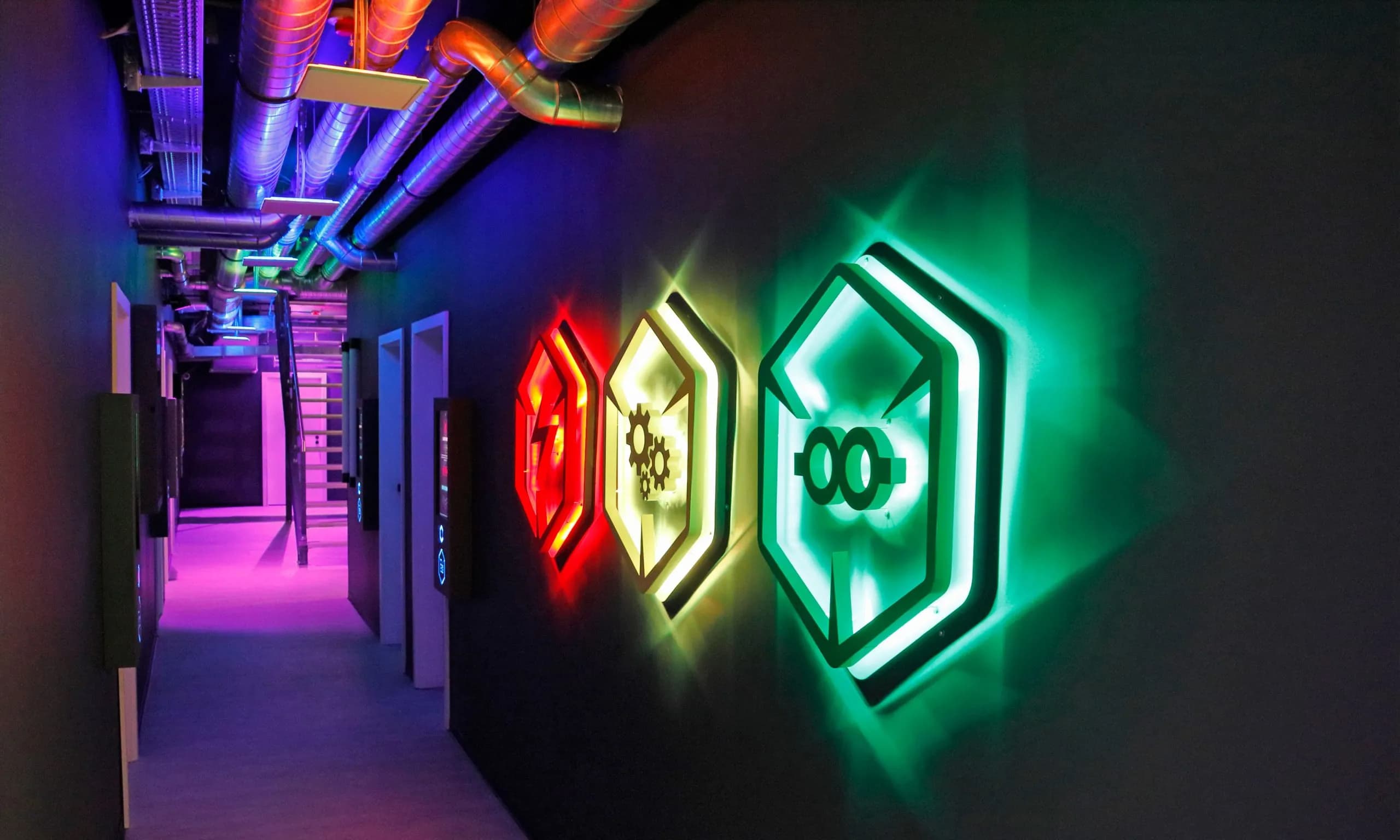
The 30 rooms are split across three categories, and you can browse every room individually before you visit.
Physical
Rooms that ask your body to do something under time pressure. In Lava Land you cross the room without touching the floor. In Laser Maze you pick your way through a web of beams. Road To Olympus is a climb against the clock. These reward agility and nerve more than raw fitness — being quick and precise beats being strong.
Brain
Rooms that are won by thinking and talking. Bomb Squad gives you a calculation to get right under pressure. Clef De Sol tests musical memory. Worlderland is a geography puzzle. These are the rooms where the quietest person in the group often turns out to be your best player.
Skills
Rooms about aim, timing and coordination. Buzzer Beater is basketball against a countdown. Hitball is about rolling and scoring. Crystal Maze asks you to guide a ball without dropping it. Skills rooms are the great equaliser — experience helps far less than a steady hand.
How a Session Runs
- Arrive and get briefed. You are shown how the wristbands and scoring work. It takes a few minutes, not half an hour.
- Pick your first room. There is no set route. Groups that spread out early get through more rooms than groups that queue together.
- Play, fail, retry. Every attempt counts toward the team total. Failing a room costs you nothing but time.
- Chase the score. The last ten minutes are usually spent going back to the one room that beat you.
A realistic expectation: no group clears all 30 rooms. That is the point — you choose what to attempt, and the rooms you skip are the reason to come back.
60 Minutes or 90 Minutes?
Both sessions cost the same every day of the week — there is no weekend surcharge.
- 60 minutes — $32.99 per person. Right for younger groups, for a first visit, or when the session is one part of a bigger day out.
- 90 minutes — $38.99 per person. The better value and the more satisfying visit. The extra half hour is when groups stop wandering and start deliberately hunting a higher score.
If you are choosing for a group that has never been, 90 minutes is the one worth booking. Most of the disappointment with a 60-minute session comes from finding a favourite room with eight minutes left.
Who It Works For
Families
The minimum age is 7, and under-13s need an adult with them. Because the rooms are short and varied, younger kids do not spend the session stuck at something too hard for them — they move on. Mixed-age groups work better here than at most venues precisely because nobody has to play the same game.
Friends and couples
Teams run from 2 to 6 people, so a pair is a perfectly normal booking. Two people can cover a lot of rooms in 90 minutes.
Birthdays
The shared score gives a birthday group something to rally around without anyone being knocked out or left watching. For party bookings, see events and parties.
School and corporate groups
Larger groups are split into teams of up to 6 and run at the same time. It surfaces who communicates well under time pressure, which is usually the point of a work booking. These are quoted individually — request a quote.
Practical Details Worth Knowing
- Ages: 7 and up. Under 13 must be accompanied by an adult. Under 18 needs a waiver signed.
- Team size: 2 to 6 people share one score. Bigger groups are split into multiple teams.
- What to wear: clothes you can move in and closed shoes. Several Physical rooms involve climbing or crawling.
- Food: there is no walk-in food or drink service. Most groups eat before or after. For private bookings and parties, food can be arranged as part of the package — ask when you request your quote.
- Booking ahead: worth it on weekends. Check live availability.
The venue is at 3185 Unity Dr, Unit 1, Mississauga. More detail on the FAQ page.
Frequently Asked Questions
Is Cube Challenges an escape room?
No. Escape rooms put you in one room with one puzzle for an hour. Cube Challenges gives you 30 separate rooms and lets you move freely between them for your whole session.
Do we compete against each other?
No — your team shares a single score. It is collaborative. Everything anyone attempts adds to the same total.
Can we retry a room we failed?
Yes, as many times as your session allows. There is no penalty for failing beyond the clock.
How many rooms will we finish?
Nobody completes all 30. Groups choose which rooms to attempt, and how many you get through depends on your session length and how you spread out.
Does it cost more on weekends?
No. It is $32.99 for 60 minutes and $38.99 for 90 minutes, the same every day of the week.
The Short Version
If you want one activity that keeps a mixed group busy without anyone sitting out, this format does it better than a single-game venue. Thirty rooms, three categories, one score, and enough variety that the quiet member of your group and the competitive one both leave having won something.