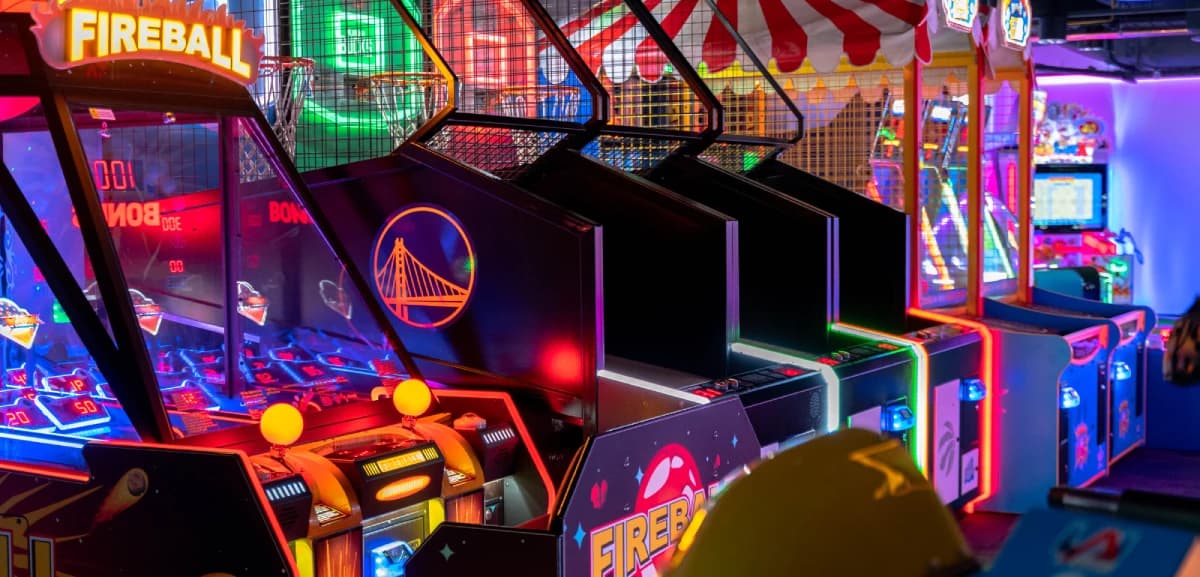
Arcades are mostly gone, and the games that filled them are forty years old, yet the format refuses to die. People still describe activities as "arcade-style" and everyone immediately understands what is meant. That is unusual for a piece of entertainment design that old.
It is worth asking why. The answer is not nostalgia — it is that arcade games were built around a very small set of rules that happen to be extremely good at holding attention. This article looks at what those rules were, and at how the same rules show up in a real-life challenge venue like Cube Challenges in Mississauga, which has no arcade cabinets at all.
To be clear up front: Cube Challenges does not have Pac-Man, Space Invaders, or any other video game machines. The classics below are history, not a menu. What the venue borrowed is the shape of an arcade game, not the hardware.
A Very Short History
Coin-operated amusements go back to the early 20th century — strength testers, fortune machines, then pinball, which was widely banned in North American cities for decades on the grounds that it was gambling. Pinball's rehabilitation in the 1970s ran straight into the arrival of the video arcade.
The late 70s and early 80s were the boom: Space Invaders, Pac-Man, Donkey Kong, Galaga. Arcades became the social venue for a generation, and the design constraints of the machines shaped the games completely. A cabinet had to earn a coin every few minutes. That single commercial requirement produced almost everything we now think of as arcade design.
Home consoles ended the arcade's dominance in the 90s, and phones finished the job. But the design language survived, because it was never really about the screens.
The Four Rules That Made Arcade Games Work
- A short loop. One attempt lasted a couple of minutes at most. You could try, fail, and be trying again within seconds.
- Instant, unambiguous feedback. You always knew exactly how you were doing. No ambiguity, no waiting for a result.
- A visible score. Something to beat — yours or someone else's — that turned a game into a reason to come back.
- Nothing to learn first. No manual, no tutorial. You understood the goal in five seconds and the difficulty did the teaching.
Every one of those is a design decision about attention, not about technology. Which is why they transfer to a physical room as easily as they did to a screen.
The Same Rules, Built Into Rooms
Cube Challenges is 30 individual challenge rooms across three categories. Each room is a short, self-contained challenge with a clock, and you and your team move between them freely for a 60- or 90-minute session.
Map that against the four rules and the resemblance is exact. Each attempt takes a couple of minutes — that is the short loop. You either cross Lava Land without touching the floor or you do not — that is the instant feedback. Every attempt feeds one shared team score through an RFID wristband — that is the visible score. And nobody explains anything for ten minutes before you start — that is the low barrier to entry.
Two things are genuinely different from a cabinet. There is no queue, because six people can be in six different rooms simultaneously and retries are unlimited while the clock runs. And the score is shared, not individual — your team pools everything it earns rather than competing internally.
The Three Categories
Physical — 10 rooms
Cardio, Laser Maze, Lava Land, Road To Olympus, Speed Barrels and others. Climbing, balance, threading through obstacles. These are about precision and nerve rather than fitness.
Brain — 7 rooms
Bomb Squad is arithmetic under pressure. Genius is faster arithmetic under more pressure. Clef De Sol is musical memory, Worlderland is geography, Rainbow Mind is pattern recall.
Skills — 13 rooms
Buzzer Beater, Hitball, Crystal Maze, Slingshot Madness, Shooting Farm, Target 8. Aim, timing and a steady hand — the closest thing to a classic skill cabinet, at room scale.
Each room carries three difficulty levels, and clearing a harder one scores more. That is the high-score chase, rebuilt: a room you have already beaten still has something left to take from you. See all 30 rooms.
Why It Works Across Ages
The old arcade was genuinely all-ages, and for the same structural reason this format is. Nothing requires prior knowledge; the three categories mean strength in one area is never the only way to contribute; and a shared score means a nine-year-old and their uncle are on the same side rather than being measured against each other.
The minimum age is 7. Under-13s need an adult with them, and anyone under 18 needs a waiver signed. Beyond that, mixed-age groups tend to sort themselves out: the kids own the Physical rooms, someone unexpected owns the Brain rooms, and the Skills rooms are anybody's.
Practical Details
- Sessions: 60 minutes at $32.99 per person, or 90 minutes at $38.99. Same price every day of the week.
- Teams: 2 to 6 people share one score. Larger groups split into several teams running at once — quoted individually.
- What to wear: clothes you can move in and closed shoes.
- Food: there is no walk-in food or drink service. Catering can be arranged for private bookings only.
- Where: 3185 Unity Dr, Unit 1, Mississauga, ON L5L 4L5.
Frequently Asked Questions
Can I play Pac-Man or other classic arcade games here?
No. There are no video game cabinets at Cube Challenges. Every challenge is a physical room you walk into.
Are there tickets or prizes?
No. There is no ticket or redemption system. Your team's score is the reward.
Is this an escape room?
No. An escape room is one room and one puzzle for an hour. This is 30 rooms you move between freely.
How many rooms will we get through?
It depends entirely on your group and how much you retry. Nobody clears all 30 — the session is about which rooms you choose to attempt.
Do we need to be fit?
No. Only one of the three categories is physical, and a group can score well while barely touching it.
What ages is it for?
7 and up. Under 13 must have an adult with them; under 18 needs a waiver.
The Short Version
Arcade games lasted because of four design rules, not because of the machines. A short loop, instant feedback, a score worth chasing, and nothing to learn first. Take those out of a cabinet and build them into 30 real rooms and you get the same pull, with the added advantage that nobody has to stand and wait their turn.